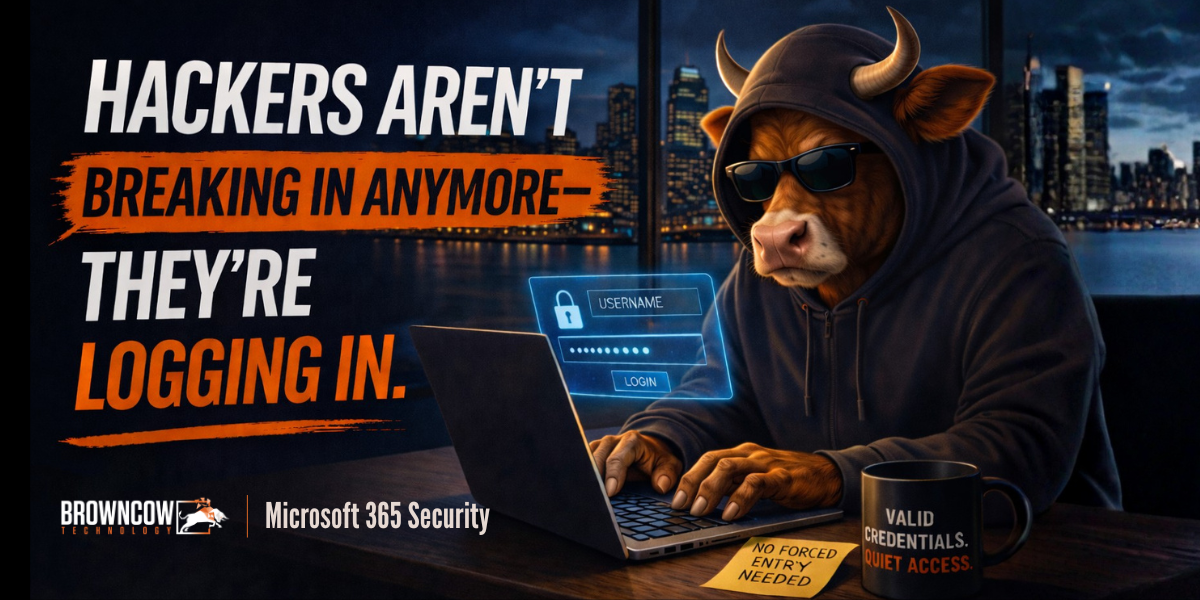
Hackers Aren’t Breaking In Anymore—They’re Logging In
Most business owners still associate cyber risk with disruption: systems going down, files being locked, operations coming to a halt.
That still happens, but it’s no longer the most common way businesses get compromised. For many organizations, this has become a Microsoft 365 security for small business issue where access is gained through valid credentials rather than forced entry.
What’s more typical now is quieter. Someone gains access using valid credentials and operates inside the business without triggering the kinds of signals most teams are trained to look for.
How access is actually gained
Most incidents start with a phishing email. Not the obvious kind, but something routine, such as an invoice, a document share, or a request that fits into the normal flow of business.
The employee interacts with it, enters their credentials, and moves on. At that point, the attacker doesn’t need to bypass anything. They sign in.
Because the credentials are valid, the activity doesn’t immediately stand out. From a system perspective, it looks like a normal user accessing their account.
Microsoft recently detailed how phishing kits are enabling account takeover
Why this is becoming more common
There are a few practical reasons this approach is becoming more common.
Email-based attacks have improved. Messages are better written, more context-aware, and often timed to align with real business activity. They don’t rely on urgency alone—they rely on familiarity.
At the same time, most small and mid-sized businesses now operate heavily within a single ecosystem, typically Microsoft 365. That’s why Microsoft 365 security for small business has become a central concern, not just an IT detail. Email, file access, internal communication, and approvals are all connected. One compromised account can expose a meaningful portion of the business.
Many organizations have also implemented multi-factor authentication, but the effectiveness varies. Inconsistent policies, over-reliance on user approval, or gaps in enforcement can reduce its impact. (Microsoft’s own guidance on multi-factor authentication)
None of this requires advanced techniques. It leverages how work already happens.
What happens after someone gets in
The immediate goal is rarely disruption.
Instead, the focus is on understanding how the business operates.
Over time, an attacker may monitor email conversations, review shared files, and observe how decisions are made. They look for patterns such as who approves payments, how vendors communicate, where sensitive information is stored.
Once they have that context, their actions are designed to blend in.
- A payment request is adjusted.
- An invoice is redirected.
- A message is sent from a familiar account with a slight change in details.
These actions don’t stand out because they resemble legitimate activity. By the time something feels off, the issue has already moved beyond IT and into financial or operational impact.
Why it often goes unnoticed
Most security measures are designed to detect abnormal behavior—malware, suspicious files, unusual system activity.
When valid credentials are used, those signals don’t appear in the same way. The login is correct, access is permitted, and the activity fits within expected patterns.
Without visibility into how people use accounts, there’s little to trigger concern. In many cases, the first sign of a problem is a downstream issue—an incorrect payment, a vendor discrepancy, or a conversation that doesn’t quite add up.
What this means for businesses in Cincinnati and Northern Kentucky
For most organizations in this region, the risk isn’t a highly targeted attack by a sophisticated group.
It’s something more routine and more likely.
- A finance employee processing invoices.
- An operations manager approving requests.
- An owner reviewing documents and communicating through email.
These are the points where access-based attacks take hold.
And because the business continues to operate normally, there’s often an assumption that issues would be obvious if they existed.
In this case, that assumption creates exposure.
How to Approach Microsoft 365 Security for Small Business
This shift doesn’t require you to overhaul your systems, but it does require a change in focus.
Instead of focusing solely on preventing access, it is just as important to understand how access is being used.
Based on federal guidance on phishing and social engineering risk includes:
- Reviewing login activity and identifying patterns that don’t align with normal behavior
- Strengthening multi-factor authentication with clear policies and enforcement, not just enabling it
- Training employees on the types of phishing that reflect current tactics, including document-based and QR-driven requests
- Limiting access based on location, device, and role where appropriate
- Monitoring account and email activity for subtle changes, not just obvious threats
In practice, these steps focus less on adding tools and more on improving visibility
A quieter kind of risk
As a result, the most significant cyber risk for many businesses today isn’t a system failure that stops operations.
Unauthorized access allows someone to observe, learn, and act without being noticed.
And the longer that continues, the more precisely that access can be used against the business.
Final Thoughts for Executive Leaders
These steps are less about adding tools and more about improving visibility and control, especially for Microsoft 365 security in small-business environments, where access is centralized.
If this feels harder to assess from the outside, that’s usually a sign it’s worth taking a closer look. Most businesses don’t have a clear view of how accounts are being accessed or used day to day, and that’s where these issues tend to sit.
If you want a second set of eyes on it, we can walk through what’s visible, what isn’t, and where gaps typically show up. Get in touch here.

PROTECTING OUR HERD FROM CYBER THREATS
Medical & Dental
Property Management
Small Manufacturing
Professional Services