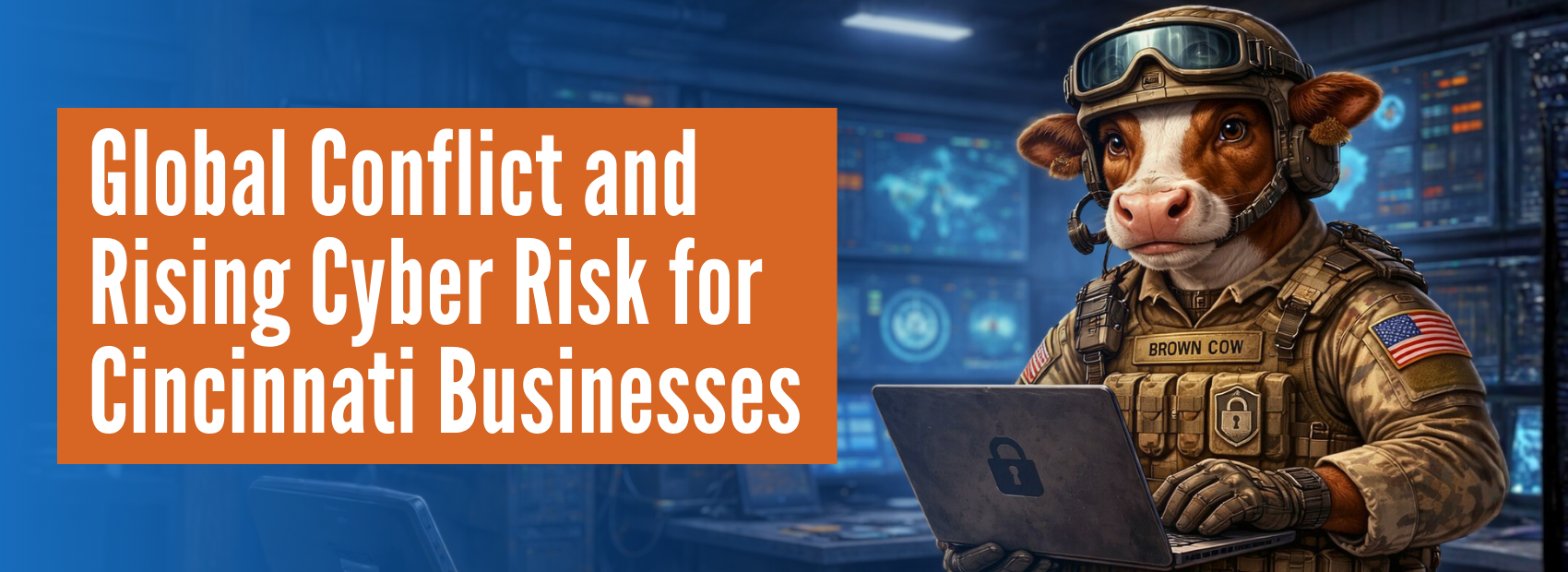
Could global conflict affect cyber risk for Cincinnati businesses?
Global conflicts rarely target small and mid-sized businesses directly. But they do change the cyber environment in which businesses operate.
When geopolitical tensions rise—whether involving Russia, China, Iran, or other state actors—cybersecurity agencies like the Cybersecurity and Infrastructure Security Agency (CISA) and the FBI routinely warn U.S. organizations to strengthen their defenses. The concern isn’t that local companies suddenly become military targets. The concern is that global cyber activity tends to increase, creating more opportunities for criminals, hacktivists, and nation-state groups to exploit weaknesses.
For businesses in Cincinnati and Northern Kentucky, this means cyber risk can rise indirectly, even if the conflict itself is thousands of miles away.
Below is an objective look at how global conflict influences cyber risk, what it means for businesses locally, and how organizations can prepare.
How Global Conflict Changes Cyber Risk for Businesses
1. Increased Nation-State Cyber Activity
During periods of geopolitical tension, governments often deploy cyber operations to gather intelligence, disrupt adversaries, or influence global narratives.
These operations typically target:
-
Government agencies
-
Critical infrastructure
-
Defense and manufacturing sectors
-
Telecommunications and logistics networks
However, businesses can become collateral exposure points. For example:
-
Suppliers to government agencies
-
Contractors supporting infrastructure
-
Companies that hold valuable intellectual property
Nation-state attackers often exploit smaller organizations as entry points into larger ecosystems.
For regional manufacturers, logistics firms, healthcare providers, and professional services companies, this risk can be relevant even if they don’t consider themselves high-value targets.
2. Supply Chain and Vendor Exposure
One of the most common ways cyber incidents affect businesses is through software and service providers.
High-profile cyber incidents over the past decade have demonstrated how attackers compromise:
-
IT management tools
-
software updates
-
cloud service platforms
-
vendor credentials
When a trusted vendor is compromised, the impact can cascade across thousands of businesses.
Global conflict increases the likelihood of state-backed groups targeting widely used platforms, because the payoff is significant.
For example, attackers may attempt to infiltrate:
-
software supply chains
-
managed service providers
-
enterprise software vendors
Even organizations with strong internal security can be affected if a third-party provider is compromised.
3. Opportunistic Cybercrime During Global Events
Most cyberattacks against businesses are not conducted by governments. They are carried out by financially motivated criminal groups.
However, global conflict often creates more opportunities for cybercrime, including:
-
phishing campaigns tied to geopolitical news
-
donation scams and humanitarian fraud
-
fake government alerts or sanctions notices
-
credential harvesting campaigns
Cybercriminals frequently use breaking news to make scams more believable.
For businesses, that means employees may encounter emails or messages that appear legitimate because they reference current events.
4. Hacktivist Campaigns and Political Cyber Activity
Periods of global conflict often lead to increased activity from hacktivist groups—actors motivated by political or ideological causes.
Hacktivists commonly target:
-
corporate websites
-
online services
-
organizations perceived to support one side of a conflict
These attacks are usually disruptive rather than destructive, such as:
-
website defacement
-
denial-of-service attacks
-
data leaks
While they rarely cause permanent damage, they can still disrupt operations or harm reputation.
Why This Matters for Cincinnati & Northern Kentucky Businesses
Cincinnati and Northern Kentucky have a diverse economy that includes:
-
manufacturing
-
healthcare
-
logistics and transportation
-
financial services
-
professional services
Many companies in the region are connected to national and global supply chains.
That means cyber risk can increase through:
-
vendor networks
-
shared software platforms
-
partner organizations
-
remote access systems
Even organizations that operate locally may rely on global technology infrastructure.
As a result, cybersecurity agencies recommend that businesses treat geopolitical tension as a reminder to review their security posture and preparedness plans.
Cybersecurity Preparedness: Practical Steps Businesses Should Take
The good news is that the most effective defenses are well-established best practices. Preparing for increased cyber risk does not require dramatic changes—just consistent execution of the fundamentals.
1. Verify Backup and Recovery Capabilities
Backups are essential, but they only matter if they work.
Businesses should ensure:
-
backups run regularly
-
backups are stored securely and offsite
-
systems can be restored quickly
-
recovery procedures are tested
Regular recovery testing is one of the most important steps organizations can take.
2. Strengthen Identity Security
Many cyber incidents begin with compromised credentials.
Organizations should prioritize:
-
multi-factor authentication (MFA) for all users
-
strong password policies
-
secure remote access systems
-
identity monitoring
MFA remains one of the most effective protections against account compromise.
3. Keep Systems Updated
Unpatched vulnerabilities remain a common attack vector.
Businesses should maintain processes to:
-
patch operating systems regularly
-
update critical software platforms
-
monitor vulnerability advisories
-
prioritize high-risk vulnerabilities
Automated patch management can significantly reduce exposure.
4. Monitor for Suspicious Activity
Early detection can dramatically reduce the impact of an incident.
Organizations should consider tools or services that provide:
-
endpoint detection and response (EDR)
-
centralized logging
-
security monitoring
Even small businesses benefit from visibility into unusual activity.
5. Train Employees to Recognize Cyber Threats
Employees remain a critical line of defense.
Security awareness training should cover:
-
phishing identification
-
suspicious attachments
-
password hygiene
-
reporting procedures
Regular training helps reduce the likelihood of successful phishing attacks.
Questions Business Leaders Should Be Asking Right Now
Executives and decision-makers do not need to become cybersecurity experts, but they should ask the right questions.
Consider discussing the following with your IT team or technology provider:
-
When was the last time we tested our backup recovery process?
-
How quickly could we restore operations after a ransomware incident?
-
Do all employees use multi-factor authentication?
-
How do we monitor for suspicious activity on our network?
-
Are our systems regularly patched and updated?
-
How secure are our vendors and software providers?
-
Do we have a documented incident response plan?
These conversations can help identify gaps before they become problems.
Frequently Asked Questions
→ Are small businesses really targets for cyberattacks?
Yes. Small and mid-sized businesses are frequently targeted because attackers assume security controls may be weaker than those at large enterprises.
→ Are cyberattacks during conflicts usually carried out by governments?
Not typically. Most business attacks are carried out by criminal groups seeking financial gain, though geopolitical events can increase overall cyber activity.
→ Should businesses change their cybersecurity strategy because of global conflict?
Most organizations do not need entirely new strategies (unless you have zero guardrails currently). Instead, they should ensure existing security fundamentals are implemented effectively.
→ Is cyber insurance enough protection?
Cyber insurance can help mitigate financial losses, but insurers increasingly require strong security controls. Insurance should complement—not replace—strong cybersecurity practices.
Final Thoughts
Global conflicts may feel distant, but they can influence the broader cyber threat environment in which businesses operate.
For organizations in Cincinnati and Northern Kentucky, the key takeaway is not panic—it’s preparedness.
By strengthening core cybersecurity practices, businesses can significantly reduce their exposure to threats that often increase during periods of geopolitical tension.
The most resilient organizations are not those that avoid risk entirely, but those that prepare for it thoughtfully and proactively.

PROTECTING OUR HERD FROM CYBER THREATS
Medical & Dental
Property Management
Small Manufacturing
Professional Services