How to Use AI at Work Without Risking Company Data
AI is already finding its way into the workday.
Employees are using it to draft emails, summarize meeting notes, clean up spreadsheets, research vendors, brainstorm ideas, prepare reports, and move through routine tasks faster. For many businesses, that kind of productivity gain is exactly why AI is worth paying attention to.
The challenge is that AI adoption often starts before the business has a plan for it.
- An employee may open a personal ChatGPT account to polish a customer response.
- Someone in accounting may upload spreadsheet data to speed up analysis.
- A manager may paste meeting notes into an AI tool to create action items.
None of those actions may feel risky in the moment, but each one can involve company data leaving a controlled environment.
That is where business leaders need to be careful.
The issue is not whether AI can be useful. It can be. The issue is whether your organization knows which tools are being used, what information employees are sharing, who has access, and what safeguards are in place.
For businesses here in Cincinnati and Northern Kentucky, this is quickly becoming a practical leadership issue. Teams want to use AI, vendors are adding AI into everyday software, and competitors are experimenting with new workflows.
The businesses that handle this well will not be the ones that ignore AI or try to block it completely. They will be the ones that create a safe, approved path for using it.
Why AI at work needs a data security plan
Most employees are not trying to create risk when they use AI. They are usually trying to work faster, get unstuck, or improve the quality of their work.
That is what makes unmanaged AI use so easy to miss. It usually does not look like a security concern. It looks like normal work.
A few common examples include:
- Pasting an email into an AI tool to make it clearer
- Uploading meeting notes to create a summary
- Asking AI to rewrite a proposal or customer message
- Using AI to analyze a spreadsheet
- Summarizing a contract, report, or internal document
- Brainstorming marketing, hiring, sales, or operations ideas
The risk depends on the information involved. A generic prompt asking for writing help is very different from a prompt that includes customer names, financial details, HR notes, legal language, pricing, patient information, internal strategy, or proprietary processes.
Once sensitive information is entered into an unmanaged AI tool, the business may not have a clear answer to basic questions:
- Where did that data go?
- Was it stored?
- Can it be deleted?
- Could it be used to improve the model?
- Who can access the account?
- Is the tool approved for business use?
- Does the business have a record of what was shared?
Those questions matter because company data does not stop being sensitive just because it was pasted into a prompt box.
The problem with letting employees figure it out on their own
A “wait and see” approach may feel reasonable when a technology is still new. With AI, that approach can quickly create blind spots.
Recent workplace research from PagerDuty found that 66% of office professionals had used AI tools at work, even when they believed those tools were not allowed by company policy. Okta’s 2026 AI workplace research also found a gap between executive confidence and employee behavior, with employees using unapproved AI tools through personal accounts.
That does not mean employees are trying to be reckless. In many cases, it means the approved path is unclear, slow, restrictive, or nonexistent.
When a team sees real value in AI but lacks practical guidance, people tend to make their own decisions. One person uses a personal account. Another tries a free browser extension. A department subscribes to a tool without IT review. Over time, the business ends up with scattered AI usage, separate accounts, unclear permissions, and little visibility into what data is being shared.
That is not a strong position for leadership.
A better approach is to make responsible AI use easy enough that employees do not feel the need to work around the business.
What company data should be protected from unmanaged AI tools?
Every business should define its own AI policy, especially if it handles regulated, confidential, or customer-sensitive information. Still, there are categories of data that should receive extra caution in almost every organization.
Employees should avoid entering the following into unmanaged or unapproved AI tools:
- Customer names, contact details, account information, or private customer conversations
- Patient, client, legal, financial, or regulated information
- Employee records, payroll details, HR notes, or performance discussions
- Contracts, proposals, pricing documents, invoices, and internal financials
- Passwords, API keys, login details, system information, or network documentation
- Confidential meeting notes, leadership discussions, business plans, or acquisition-related information
- Internal processes, proprietary workflows, product plans, or intellectual property
Some of these are obvious. Others are easier to overlook.
Meeting notes are a good example. On the surface, they may seem harmless. In reality, they often contain customer issues, staffing concerns, pricing decisions, financial updates, vendor details, or internal strategy. If those notes are uploaded to an AI platform the business has not reviewed, leadership may have no visibility into what was shared.
That is why AI training should focus on real work scenarios, not abstract warnings. Employees need to understand what safe use looks like in the context of their actual jobs.
Why banning AI rarely solves the problem
Some businesses respond to AI concerns by telling employees not to use it at all. That may sound safer, but it often pushes usage further out of sight.
If AI helps someone finish a task faster, they may still use it. If the business does not provide an approved option, they may choose whatever tool is easiest to access. If the policy feels unrealistic, employees may avoid mentioning AI altogether.
That creates a worse situation for leadership: AI is still being used, but now the business has less visibility.
A more practical approach is to set boundaries around approved use. That means giving employees clear answers to questions they are already asking:
- Which AI tools are approved for work?
- Can personal AI accounts be used for business tasks?
- What information should never be entered into AI tools?
- Which use cases are encouraged?
- Which use cases require review?
- Who should employees ask when they are unsure?
- How will AI usage be monitored or managed?
The goal should not be to make AI feel off-limits. The goal should be to make safe AI use clear, accessible, and supported.
AI agents make access control even more important
Many people still think of AI as a chatbot: you type a question, get an answer, and move on. That model is already expanding.
More AI tools are becoming connected to business systems. Some can access documents, email, calendars, cloud storage, customer records, ticketing systems, or other applications. These more advanced tools can perform multi-step tasks, retrieve information, and in some cases take action with limited human involvement.
That creates a significant opportunity, but it also raises the stakes.
If an AI tool can access company files, the business needs to understand which files. If it can interact with email, the business needs to understand what it can read or send. If it can connect to a CRM or ticketing system, permissions need to be handled carefully.
AI access should be reviewed with the same seriousness as employee access. Business leaders should know who can use the tool, what it can access, what data it can process, what activity is logged, and who is responsible for oversight.
As AI tools become more capable, governance can no longer be an afterthought.
AI is part of the cybersecurity conversation now
AI also matters because attackers are using it.
Anthropic recently published research on AI-enabled cyber activity after reviewing hundreds of banned accounts associated with malicious cyber behavior. The report found AI being used beyond basic phishing support, including activity that can help attackers during later stages of an intrusion.
For business leaders, the takeaway is straightforward: AI is no longer just a productivity topic. It now belongs in the broader cybersecurity and risk management conversation.
Your business should be thinking about AI from both sides. Internally, how can employees use AI safely and productively? Externally, how could attackers use AI to make scams, social engineering, or cyberattacks more effective?
Ignoring either side creates a blind spot.
What a safer AI rollout should include
A safer AI rollout does not need to be complicated, but it does need structure. Before employees are encouraged to use AI for business tasks, leadership should be able to answer a few key questions.
- First, the business needs an approved set of tools. Employees should know which AI platforms are acceptable for work and which ones are not. This helps prevent company data from being scattered across personal accounts, free apps, and unreviewed tools.
- Second, the business needs clear data rules. Employees should understand what information can be used with AI, what information requires caution, and what information should never be entered into an unmanaged platform.
- Third, access needs to be managed. If AI tools are being used for business purposes, accounts should be handled like other business technology accounts. That includes onboarding, offboarding, role changes, permissions, and administrative visibility.
- Fourth, employees need practical training. A generic warning about “being careful with AI” is not enough. Teams need examples that match their roles, whether they work in operations, finance, sales, HR, customer service, leadership, or technical functions.
- Finally, the business needs ongoing oversight. AI tools are changing quickly, and new features are being added all the time. A policy created once and forgotten will not be enough. Leadership, IT, and security should review AI usage regularly as the tools and use cases evolve.
The Cincy business takeaway:
Cincinnati and Northern Kentucky businesses do not need to sit out on AI because of risk. They should also not let AI adoption happen quietly across the organization without a plan.
The better path is managed adoption.
That means giving employees a safe way to use AI while protecting the information the business is responsible for. It means creating guardrails before sensitive data ends up in the wrong place. It means helping the team use AI with confidence instead of confusion.
For many small and mid-sized businesses, the biggest AI question is not whether the technology is useful. It is how to introduce it without creating unnecessary exposure.
That is exactly where a managed approach matters.
Give your team AI access (without risking company data)
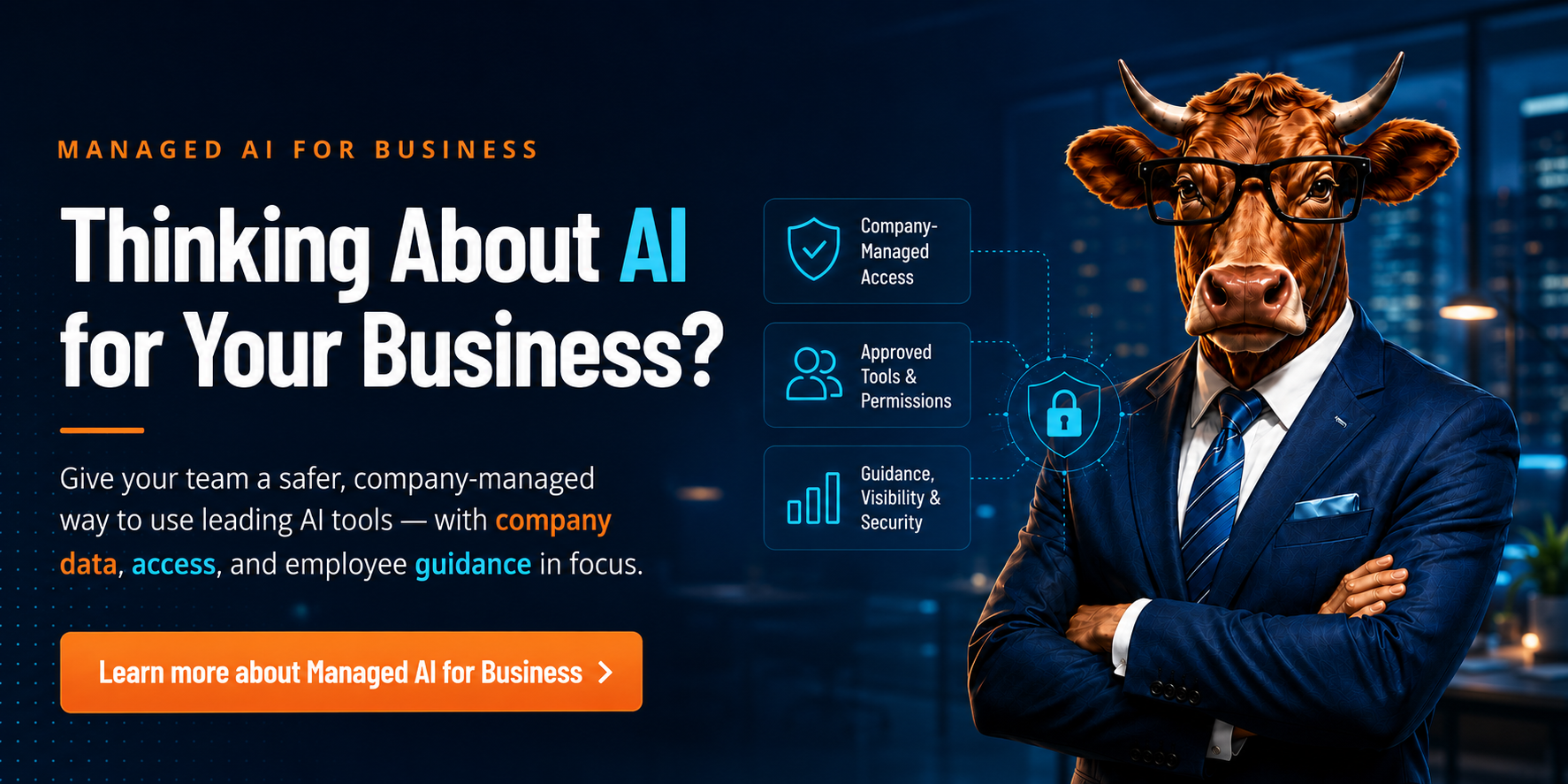
AI does not need to be rolled out all at once, nor should it be left to each employee to figure out on their own.
For many small and mid-sized businesses, the next step is simply creating a safer path: approved access, clear expectations, data guardrails, and support as employees begin using AI in everyday work.
That gives your team room to use AI productively while helping the business stay in control of company data, accounts, and usage.
If your business is ready to move beyond scattered AI tools and personal accounts, BCT Managed AI can help you start with more structure and less risk.
Explore our Managed AI Packages or schedule a conversation to talk through a safer rollout for your team.
Your team is probably already using AI.
Let’s make sure your business is ready for it.
Related Resources:
- Managed AI for Business
- Hackers Aren’t Breaking In Anymore—They’re Logging In
- Cyberattacks in Cincinnati — and the Security Gaps They Exposed
- How Cincinnati SMBs Can Use AI Safely—and Actually See ROI
- RAM Price Surge and What It Means for Cincinnati IT Budgets
- Penetration Testing Services for Compliance, Regulation, and Cyber Insurance


PROTECTING OUR HERD FROM CYBER THREATS
Medical & Dental
Property Management
Small Manufacturing
Professional Services