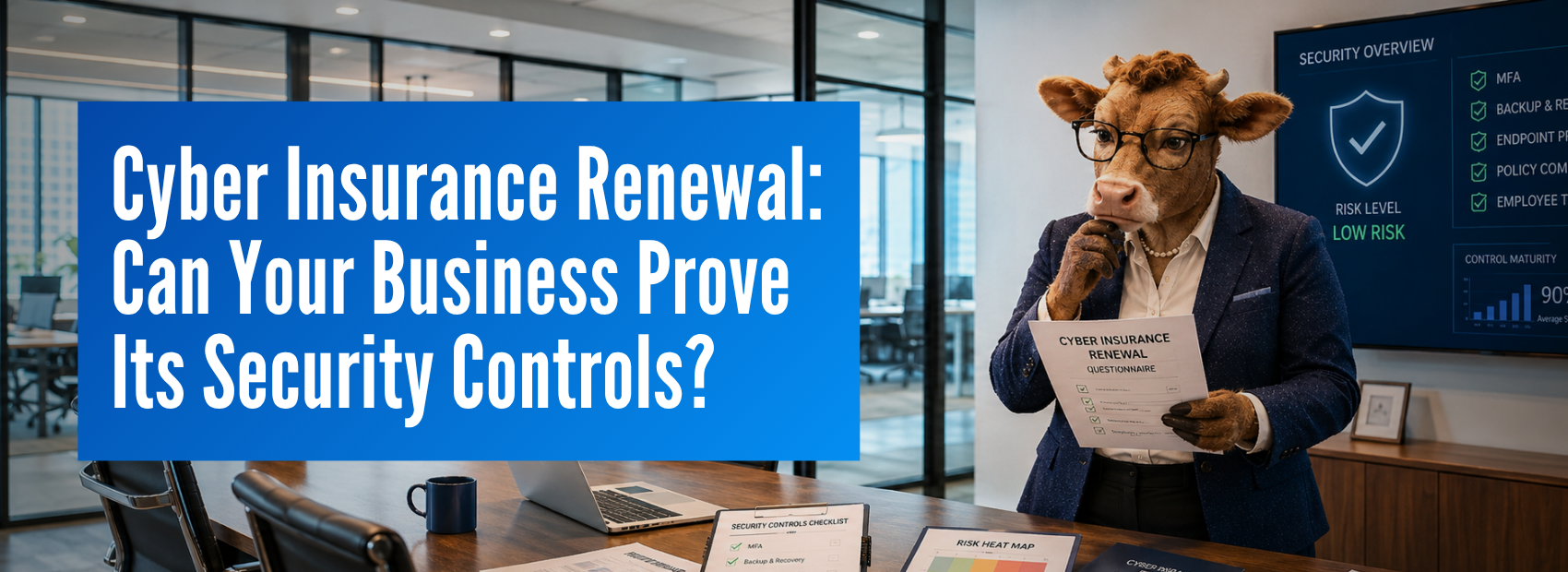
Cyber Insurance Renewal: Can Your Business Prove Its Security Controls?

Cyber insurance renewal used to feel like a paperwork exercise for many small businesses. Answer a few questions, confirm you have basic protections in place, review the premium, and move on.

That is changing.

For businesses in Cincinnati and Northern Kentucky, cyber insurance renewal warrants closer attention. Insurers are asking more specific questions about security controls, documentation, and recovery readiness. The issue is not just whether your business has cyber insurance. It is whether your answers on the application match what is actually happening inside your IT environment.

That distinction matters. Cybersecurity Dive recently reported that cyber insurance policyholders are facing heavier scrutiny in both underwriting and claims, with insurers placing more emphasis on security controls, technology dependencies, and exposure to larger cyber events. Businesses with weaker cyber hygiene may face more restrictions, while better-prepared organizations may have access to stronger terms.

For business leaders, the takeaway is straightforward: before you renew, make sure your IT controls can withstand the questions being asked.

Cyber insurance is not a substitute for cybersecurity

Cyber insurance can be an important part of your risk management plan. Depending on the policy, coverage may help with breach response, legal defense, identity recovery, data restoration, business income loss, cyber extortion, ransomware response, and public relations expenses after a cyber incident. Cincinnati Insurance, for example, lists coverage categories such as breach response, computer attack recovery, business income loss, cyber extortion, data compromise liability, and network security liability across its cyber risk products.

But cyber insurance does not remove the need for strong security controls. In many cases, the policy depends on those controls being present, enforced, monitored, and documented.

That is where many small businesses get uncomfortable. They may assume they have MFA because Microsoft 365 offers it. They may assume they have backups because a backup job runs each night. They may assume they have endpoint protection because antivirus is installed. They may assume employees know what to do because phishing has been mentioned in a staff meeting.

Those assumptions can become a problem when the renewal application asks for a yes-or-no answer.

→ The real question: can you prove it?

Insurance applications are getting more specific because cyber incidents are expensive, disruptive, and often tied to preventable control gaps. Coalition’s 2026 Cyber Claims Report found that attacks involving both data exfiltration and encryption accounted for 70% of ransomware claims in 2025, and those dual-extortion incidents were twice as expensive as encryption-only claims, averaging $302,000. Coalition also reported that business inboxes remain a primary battlefield for financial loss, with funds transfer fraud increasingly tied to compromised credentials and direct attacks on financial systems.

That is why insurers care about more than whether tools exist. They want to understand whether those tools reduce risk in practice.

A good cyber insurance renewal review should focus on evidence. Can your business show that MFA is enforced? Can you produce backup test records? Can you confirm endpoint alerts are monitored? Can you document employee training? Can you explain who handles incident response if something happens after hours?

→ If the answer is “I think so,” renewal is the right time to verify.


1. Multi-factor authentication needs to be enforced

MFA is one of the most common cyber insurance requirements, but the details matter. It may not be enough to say MFA is “available” or “turned on.” Insurers may ask whether MFA is enforced for all users, administrator accounts, remote access, email, cloud applications, and critical systems.

CISA’s small-business cyber guidance recommends mandating MFA alongside technical controls, especially for administrator accounts. CISA also recommends patching, testing backups, removing unnecessary administrator privileges, and protecting devices with encryption.

Before renewal, leadership should be able to answer:

  • Is MFA enforced for every user account?
  • Are administrator accounts protected separately?
  • Are remote access tools protected by MFA?
  • Are any users, locations, or applications excluded?
  • Can we produce a report showing MFA coverage?

This is one of the easiest places for a business to overstate its security. “We use MFA” and “MFA is enforced everywhere the policy expects it” are not always the same thing.

2. Backups need to be tested, not assumed

Backups are one of the most important controls in a ransomware or data-loss event. They are also one of the easiest controls to misunderstand.

A backup system can appear healthy while still failing when the business actually needs to restore from it. Files may be incomplete. Restore points may be too old. Backups may be connected to the same environment attackers compromised. Cloud sync may replicate encrypted or corrupted files. Nobody may know the true recovery timeline.

Recent cyber insurance guidance has focused heavily on whether backups are isolated, monitored, tested, and documented. Insurers are asking more detailed backup questions, including whether backups are isolated from the primary environment, tested regularly, monitored, and tied to a validated recovery time objective.

Before renewal, leadership should be able to answer:

  • When was our last successful restore test?
  • Are backups isolated from the main network?
  • Who monitors backup failures?
  • How much data could we afford to lose?
  • How long would it take to restore critical systems?
  • Do we have documentation of restore testing?

For an executive team, the important question is not simply whether data is backed up. It is how quickly the business could recover payroll, billing, email, client files, scheduling, production, or patient operations after an incident.

3. Endpoint protection may need more than antivirus

Traditional antivirus may not meet the expectations of a cyber insurance carrier today. Many renewal questionnaires now ask about endpoint detection and response (EDR) and managed detection and response (MDR).

The difference matters. Antivirus is usually focused on blocking known threats.

  • EDR is designed to detect suspicious behavior on endpoints such as workstations and servers.
  • MDR adds human monitoring, investigation, and response support around those alerts.

Huntress notes that underwriters often expect EDR to be in place and actively monitored, and they may ask for proof that alerts are reviewed. Huntress also identifies training records, monitoring logs, email security controls, backup testing, patch management, privileged access controls, logging, incident response plans, and vendor risk assessments as common proof points for carriers.

Ask your IT provider:

  • Are all workstations and servers covered by endpoint protection?
  • Is it EDR/MDR or only basic antivirus?
  • Who receives security alerts?
  • Are alerts monitored after hours?
  • Can we produce deployment and monitoring reports?
  • What happens when suspicious activity is detected?

This is especially important for businesses with remote employees, shared workstations, aging computers, or employees who use personal devices for business tasks.

4. Security awareness training should be documented

Many cyber incidents still begin with a person: a clicked link, a fake invoice, a stolen password, a fraudulent payment request, or a convincing message that appears to come from a vendor, executive, bank, or IT support contact.

Training does not eliminate that risk, but it helps employees recognize and report suspicious activity faster. From an insurance perspective, the documentation matters too. A carrier may ask whether training happens annually, whether employees complete it, whether phishing simulations are performed, and whether completion records exist.

This does not need to become complicated. Businesses should be able to show who was trained, when the training happened, what topics were covered, and how new employees are onboarded.

Before renewal, leadership should be able to answer:

  • Do employees receive security awareness training?
  • Is training documented?
  • Are new hires included?
  • Do employees know how to report suspicious emails?
  • Are phishing simulations or practical examples used?
  • Is leadership included in training?

For small businesses, this is often one of the most affordable ways to reduce risk. It also shows an insurer that cybersecurity is not treated as an IT-only issue.

5. Incident response plans need clear ownership

A cyber incident is a bad time to decide who is in charge.

Insurers are paying closer attention to response readiness because fast decisions can limit damage. The Wall Street Journal recently reported that cyber insurers are looking beyond installed controls and asking how quickly companies can respond when defenses fail, especially as AI may accelerate the time between vulnerability discovery and exploitation.

A useful incident response plan does not need to be a 60-page binder. It needs to answer practical questions before emotions, downtime, and uncertainty take over.

Prior to renewal, businesses should ask their IT provider:

  • Who makes decisions during a cyber incident?
  • Who contacts the insurance carrier?
  • Who contacts legal counsel, law enforcement, clients, vendors, or regulators if needed?
  • Who can shut down access, isolate systems, or reset credentials?
  • Where is the plan stored if email or files are unavailable?
  • Has the plan ever been tested?

CISA’s ransomware guidance recommends creating, maintaining, and regularly exercising an incident response plan and communications plan, including response and notification procedures for ransomware, data extortion, and breach incidents. It also recommends keeping a hard copy and offline version of the plan available.

That last point matters. If your incident response plan only lives in the same system that gets locked or compromised, it may not help when you need it most.

6. Your renewal answers should match your real environment

The risk for many small businesses is not intentional misrepresentation. It is assumption-based answering.

Someone fills out the renewal form and answers “yes” because the control exists somewhere, was discussed once, or is included in a tool the business owns. But cyber insurance questions are increasingly asking whether controls are fully deployed, actively monitored, and consistently enforced.

That difference can matter during underwriting and after a claim. Inaccurate information on a cyber insurance application can create serious coverage issues, including claim denial or policy rescission, depending on the facts, policy language, and applicable law.

This is why cyber insurance renewal should involve both your insurance advisor and your IT provider. Your broker can explain what the policy requires. Your IT provider should help verify whether the technical answers are accurate.


Cyber Insurance Renewal Checklist

What to review before cyber insurance renewal

Use this checklist before your next renewal conversation. The goal is to confirm that your answers match the controls your business actually has in place.

01

MFA and access control

Confirm MFA is enforced across users, administrators, email, cloud apps, and remote access. Review any exceptions carefully.

02

Endpoint protection

Verify whether you have EDR or MDR, not just traditional antivirus. Confirm who monitors alerts and how response is handled.

03

Backups and recovery

Review backup coverage, isolation, monitoring, restore testing, recovery timelines, and documentation.

04

Email security

Confirm protections against phishing, impersonation, malicious attachments, suspicious links, and unauthorized forwarding rules.

05

Patch management

Review whether operating systems, applications, firewalls, and network devices are patched consistently.

06

Admin privileges

Confirm users do not have unnecessary administrator access. Review privileged accounts separately.

07

Security training

Make sure employee training is documented and repeatable for current employees and new hires.

08

Incident response

Create or update a practical response plan with names, responsibilities, escalation steps, and offline access.

09

Logging and reporting

Confirm whether your business can produce the reports an insurer may ask for during renewal or after a claim.

TL;DR → Cyber insurance renewal is a business risk conversation

The best time to find a control gap is before the renewal form is submitted. The second-best time is before an incident happens.

For Cincinnati and Northern Kentucky businesses, cyber insurance renewal is a chance to step back and ask whether your cybersecurity program is actually supporting the business. The goal is not to chase every possible tool or turn your company into a security department. The goal is to make sure the controls your policy depends on are in place, working, and documented.

If your business is renewing cyber insurance soon, BrownCOW can help review the IT controls behind your application, identify gaps, and help you answer with more confidence. Cyber insurance can help after something goes wrong. Strong controls, clear documentation, and a tested response plan can help prevent a single incident from becoming a much larger business problem.

Free Cyber Risk Consultation

Not sure your cybersecurity would hold up under review?

Cyber insurance renewals, security questionnaires, and client requirements are asking businesses to prove their IT controls are actually in place.

Review cyber insurance and security requirements

Strengthen MFA, backups, endpoint protection, and email security

Identify gaps before they become expensive problems

Monitor systems 24/7 with real-time protection

Schedule a Free Cyber Risk Consultation

We’ll help you understand what’s protected, what needs attention, and what to review next.

BrownCOW Technology helps steer your IT in the right direction

PROTECTING OUR HERD FROM CYBER THREATS

Medical & Dental

Property Management

Manufacturing

Professional Services